Wednesday, March 25, 2009

Snapping Shots of Maple Ridge & Pitt Meadows

ABOVE: floats for fishermen's nets await their turn to bob in the Fraser River

Annette and I took advantage of a nice sunny day and the later daylight hours to take a few photos in the Maple Ridge - Pitt Meadows areas alongside the Fraser River.

One of the places we went was a working dock for fishermen; small fishing boats tied up at the rivers edge and no frills marine shops on the surrounding roads let you know this was a blue collar area.

The second was a new subdivision at the end of Bonson Road in Pitt Meadows; this was the site of an old lumber mill. The site has been reclaimed and the contaminated fill trucked away, to be replaced with cleaner land. Many new smaller homes and townhouses have filled in the landscape; a walking trail at the river's edge, along with an open grassy area provides the families access to the Fraser River to sit and view the working boats go buy. A great view of the new Golden Ears Bridge can be had here as well....

You may view the photos by clicking here to go to my Flickr account.......ensure you click on "slideshow" in the upper right corner to start the show................if you want to see the captions for each picture, move your mouse to the upper right of the picture area and click on "Show Info"

Monday, March 23, 2009

New West & Surrey Caching

ABOVE: Caboose at Carre Heritage Square in Mallairdville


Had a fun filled day of caching with Bowser98, TRWFAN, and MrTJ in the New Westminister and Surrey areas on this past Sunday, a glorious sunny day on one of the first days of Spring.

We met up in New West at Moody Park to look for a couple of caches there, then we moved through New West picking off several more caches before we headed over the bridge to Surrey.

One of the nicer places we visited was earlier in the morning while MrTJ and I were on our way in from Maple Ridge. We stopped off in Coquitlam in the Mallairdville area so I could grab a cache at the Carre Heritage Square, the centre piece of Mallairdville celebrating the French heritage of the area.

You can find a good write up on the history of the area here

This is a living museum, with several original buildings on site, such as Mackin House and the CPR railway station. The local community have done a wonderful job of presenting the history of the area through means such as informative sign boards on the grounds, plus they have various activities through out the year.

Let's zoom back over to New West where we continued picking off caches around the Royal City, then we caravanned over the Patullo Bridge to continue caching along the Scott Road corridor.

On the trail in a wooded area on our way to the cache called "Hmscherlic Speaks" we came across a male Pileated Woodpecker who let us get very close to him; I took the opportunity to shoot some good close up video of him pecking at a small stump. As for the cache Hmscherlic Speaks, well, that's a whole story to itself....you have to read the log write ups from the various cachers; go to GCZV20 and view the stories written about this cache!

Another of my favourite places to visit during the day was Burns Bog; there are two caches there we had not yet done. And being no fools, we knew it was a lot better to go in the cool weather, than in the warm summer months. The last cache we did here was called "Plasma Bandits", and they lived up to their name. We were swarmed as we searched for that cache, so today was the day we picked to find this one before the little pests awoke from their winter slumber.

On the day we searched for a total of 21 caches, with 19 found and two DNFs where the caches had been muggled...not bad for the amount of driving involved....

As usual, it was more fun to get out and stretch our legs than it was to add up the numbers to our creds; having said that, I was glad to finally get to the 1600 mark. With the poor weather and the snowy winter, I had been hovering around the 1580'ish mark for what seems like forever. Glad to get that minor milestone out of the way....it felt like a little hump I just couldn't get over...not irritating or annoying, but still satisfying to get past it nonetheless....

Video can be viewed by clicking in the centre of the image below: enjoy!!

Monday, March 09, 2009

Fear Caching 101


Hate sticking your hands into dark crevasses looking for a cache and instead find something gooey and warm? EWWW!!

Well then, you would have hated this caching event - it was all about bugs and goo and dead things and squirming live things - some which may have been edible!

The twisted genius of a cacher known as Pearlwind, backed up by his equally sick compatriots The Tulameen Turtles held a caching event called "Fear Caching - 101"!

The event was all about conquering your fears of wiggly, gooey things by making you stick your hand into ammo boxes filled with all kinds of things from broken glass to squiggly worms, and some other substances that defined identification, (I hope it wasn't pureed bug guts)

This was all in an effort to find 10 clues that would lead you ultimately to a cache hidden on the grounds of the hotel where the event was held. In the cache was the secret combo to the small safe back in the meeting room.

Part of the search involved going up to room 239 where a suicide had taken place; a desparate cacher had gone mad from his last DNF and drowned himself in the in-suite jacuzzi. Not sure when he had done this, as all that was left was just his bones. Of course some sick individual had stuck some tags on the poor fellow and made a TB out of him!

Many cachers trooped up to the room to search for clues; once there you had to A) read the suicide note, and B) phone the room's voicemail box to retrieve another clue.

If that wasn't enough for you, there was a scavenger hunt to be done; pretty sure it involved sticking your hand into a small hole in an 8 foot stump; inside the hole was bugs, lots and lots of bugs, all squirming in their own juices.... cough, cough, haaaack....sorry, must have been a bug in my throat.

Not real bugs of course, but those brave enough to try were rewarded with slimy hands that took for ever to wash off...that part was real!

There was a great turn out for this event, as it seemed to strike a chord with all cachers who could honestly say "been there - done that" when it came to the icky, unidentifiable stuff on your hand after you have reached under a rock or in between tree roots.

Of course, the ones that had the most fun were the kids - all that yucky stuff was pure heaven for them, and they were the bravest of the lot.

It was a momentous undertaking by Pearlwind to stage the event, and one had to slow down on the hunt to really appreciate the attention to detail both in the main event room, and up in room 239. That's not to mention the other clues hidden around the hotel in various public areas.

Every one raved about the fun they had in their Attended logs on the cache page, and all agreed that it was one of the most fun events they have been to. Caching is a family sport, and this event was made in heaven...err..hell just for the little ones.

You can view the video by clicking on the image below...

Tuesday, February 24, 2009

Geocaching 101 Coquitlam - 2009


Over the past couple of weekends, the British Columbia Geocaching Association (BCGA) held several meet and greets around the province to welcome, and educate, the newer members of the sport.

MrTJ and myself attended the event in Coquitlam as these events draw not just the new folks, but the long time cachers as well. It's always a good time catching up with the friends you have made through the sport, as well as meeting the new members just coming on board.

The BCGA did a good job of gearing this to the new members as most of the day's events centered around ideas like; how to use your GPSr, what are the different types of caches, what does a cache look like, etc. Plus, there were 10 caches hidden around the area where cachers of all skill level could get some practice on different hides, especially the ones that encouraged you to "think outside the box".

Plenty of people attended the event, but as most of them were outside either looking for the caches or on a learning walk-about with a BCGA member, the first impression was of a poor turnout. Not so....everyone was outside having fun! As it should be....

There were also door prizes to give away, as well as an opportunity to sign up for a membership in the BCGA. Being a member adds your voice to other cacher's voices as we deal with various levels of government on issues that affect our sport.

The laughs for the day came when two keep-away TBs showed up; a keep-away TB is travel bug that's specific mission is to be kept away from another cacher. In this case, the two TBs were required to stay away from the cachers known as "Best Red" and "The Tulameen Turtles".

Best Red's TB is a huge Panda Bear that she had chosen as a door prize at a Christmas event. Unfortunately for her, the Panda Bear was quickly absconded and made a keep-away TB of which she has only had fleeting glimpses since.

Today she got within arms length of her bear, but the poor panda was sternly protected by the current TB holder, and Best Red never had a chance to hold her baby... :)

The other keep-away TB is called RainForest Rudy; Rudy is a small cuddly bear reminiscent of a Paddington Bear. Rudy is outfitted for a safari, sporting appropriate safari clothes, hat, and a tag-along green tree frog that sits on his head.

Rudy was in my posession for a few weeks, and he had the good fortune of spending a day of caching with myself, MrTJ and Bowser98, three brothers whom enjoy a good day's worth of caching. I took along my camcorder and made Rudy the star of the day; his face was in every cache hunt I recorded; of course, I had to tell Kris (Mrs Tulameen Turtle) all about the video!

I don't know how well that went over, as I never heard from her....hmmmm....

Come time for Geocaching 101, it was also time for Rudy to move on and stay with another friend. The cacher known as Scruffster thought he would love to adopt Rudy and carry on the tradition of keeping Rudy away from The Tulameen Turtles.

Well, where I was subtle in the way I went about pointing out the fact that I had Rainforest Rudy and Mrs. TT did not, Scruffster had all the savoir faire of a backwoods hillbilly. A couple of times Scruffster waved Rudy in Mrs. TTs face, and twice Scruffster was forced to run for the hills to avoid a whupping.

By the end of the event Scruffster still had Rainforest Rudy in his posession, locked safely in his car. Rudy went home with Scruffster, and, since then, a mini-Scruffster has been added to Rudy's entourage.

You can view the video of the event by clicking in the centre of the image below:


Monday, February 09, 2009

Surrey Bend Cache Tracks on EveryTrail.com

I uploaded my track from the day of caching in the Surrey Bend area to the web site called EveryTrail.com.

This is where you can view all sorts of GPS routes from skiing to walking to 4X4 trips in many parts of the world. You should check it, you might pick up some future trips for yourself!

You can view the full map and story on the EveryTrail.com website here

TIP: When the map draws in, choose a different view from the drop down menu in the upper right corner. I like the "Hybrid" view myself.
Then ZOOM in on the map to see the region better....................................


Surrey Bend & North Surrey Caching at EveryTrail

Sunday, February 08, 2009

Caching in Surrey Bend Regional Park


Had the pleasure of getting out and caching today with Bowser98 and MrTJ in the North Surrey area. We tackled the overgrown riverside trail in Surrey Bend Regional Park as we aimed to knock off the four caches along the trail while the weather was somewhat good and the bushes and brambles had fallen back for the winter.

The Surrey Bend Park is accessed from the parking lot of the Barnston Island ferry near the north foot of 176 Street. There are a couple of caches on the small island (to drive around the island is approx 11K), but there is no public parking allowed on the island. These two caches are best done as a bike ride on a warm summer day.

The first two caches we hit were Festive Tree and The Bridge; these caches are in the main part of the park and the trail to the cache areas is flat and more or less maintained. Except for today, the snow on the ground made it a bit of a chore as we walked along the path, slip sliding around on the snow.

After these caches, there is a small creek that empties into the Fraser River and you have to dip down into the creek bed to cross the creek. Sounds easy, except as the creek bed is at river level; when the tide is high, the creek bed is under 3 feet of water. You would need hip waders to get across!

"Tide" you say? "This is a river, there's no tide here"!

Oh, but there is....the Fraser River water levels are affected by the tides all the way up river to the town of Mission; approx 60 miles from the Pacific Ocean.

To help you plan your visit, here is a web site for local Vancouver area tide levels. Click here to go to the web site.

After you cross the creek, the trail is unattended and at best is described as overgrown and unmaintained. In sections the trail can be indiscernable from the surrounding bush, and where the trail skirts the river edge, is eroded away with just the slimmest bits of land for you to walk along. Not a place for the kiddies; in the summer the bushes overgrow the trail making it hard to even see your feet as you stumble along. Ensure you keep your mouth closed, as the spiders just love to build webs across the trail in the dense overgrowth.

Cache #3 is called "Happy New Year", and we were very happy to find this one as it apparently had been moved from it's original location by approx 100'. After we gave up looking for it, Bower98 noticed it further down the trail sitting out in the open; on our return from cache #4 we picked up the cache and took it back to it's original hide.

Cache #4 is called Rivershore by the hider named Fungi (a made up name); there are two large cottonwood trees on the bank of the river that have large fungi growing out from the trunks. It was neat to see how the fungi had colonized the trees.

With #4 found, we retreated our steps the mile back to the cars by the Barnston Island ferry dock, and continued on caching in North Surrey.

Watch the Surrey Bend video by clicking on the image below;


For the rest of the day we were mostly in the Tynehead Park area where the snow was still on the ground; between the snow and the boggy grounds we managed to get our feet wet and they stayed that way for the rest of the day.

Watch the the Surrey - Tynehead video by clicking on the image below:


Sunday, January 18, 2009

Abbotsford Meet & Greet

The Chilliwack Caching group held a mid-winter meet and greet in a local restaurant as a way of keeping cachers in touch with each other. Not many folks have been out for the past few weeks with all the snow and freezing temperatures, so this was a good chance to say "hello" again to old friends and meet some new ones.

They meet was held in Abbotsford to make it a bit more central to Chillwack cachers coming from the east, and Lower Fraser Valley cachers coming from the west.

It was good to see familiar faces again, and it was also good to see some new faces; some folks were just starting out in the sport, and others hadn't attended past events as they were too far away from home.

Oh, if you are wondering why some folks are walking around with towels around their neck, it's part of a challenge cache where you have to find 42 caches in one day, have your picture taken with 42 cachers, find 42 geocoins, etc, and the towel around your neck is part of the challenge..

I made a short video of the day and you can see it by clicking on the arrow in the screen below.

Enjoy!


Sunday, January 04, 2009

Snow...And Lots of It !!

ABOVE: my house in the snow

Made a short video about all the snow we have here in Maple Ridge; it started Dec 22 and pretty well kept coming until today, Jan 3 2009.
You can watch the video by clicking in the centre of the image below...


Tuesday, December 30, 2008

Where Do You Come From?

It's always interesting, if not surprising, to see what part of the world my visitors come from. While it's not always possible to identify exactly where they are, here's a sampling of my last 100 visitors.

In Canada; Toronto, Ontario; Churchill, Manitoba; Swift Current, Saskatchewan; Calgary and Lacombe in Alberta; Kelowna, Invermere, Summerland, Squamish, Nanaimo, Chemainus, Victoria all in B.C. as well as many Lower Mainland areas.

In the U.S.; New Hampshire; Kansas; Seattle, Redmond both in WA; Hillsboro, Vancouver and Portland in OR; L.A. in CA;

Around the world: St. Vincent and The Grenadines in the Carribean; Wolverhampton, London, and Dorset in the U.K.; Bern, Switzerland; Venice, Italy; Jordan, Amman; Chendu and Shanghai, China; and Canberra, Australia.

I'm sure not everyone is coming to read about geocaching and back road driving in BC, but I do get a large number of hits from people searching for topics I have covered in my trip reports. I guess I have posted enough subject material on the 'Net that my logs are high up on the search engine's scans.

Still, nice to see that it's not just local folks enjoying my view of Beautiful B.C.!

Sunday, December 07, 2008

Squamish - Lillooet - Fraser Canyon Trip (A Story From The Archives)

ABOVE: Cayoosh Creek drains Duffey Lake and heads east towards the Fraser River

Hosted by Ed Pedersen

In Attendance

Cheryl Steele from Everett
Amanda Pedersen from Maple Ridge
Jeanine Albert from Pitt Meadows
Ed Pedersen from Maple Ridge

Rain, sun, then rain, then clouds, then sun, then, well you get the idea...We were hoping for a bright sunshiny day to get the full benefit of the mountain vistas we were to be traveling through today, but that was not to be.

We left our North Vancouver rendezvous point around 9.30 AM after waiting for any last minute stragglers that might appear. As Cheryl ( CJ ) was riding by herself Amanda opted to ride with CJ for the day to keep her company. We traveled west along highway #1 through West Vancouver and turned north at Horshoe Bay to begin our trip on Hwy #99, also known as the Sea to Sky Highway.

For the next twenty miles we were treated to soaring cliffs on one side of us, complete with runaway creeks that often cause road problems during the winter. Even the cliffs themselves have been somewhat tamed; in sections they are covered with wire mesh, or even cemented over to try and control the rock face that crumbles and continually falls onto the road.

On the other side of the highway was an expansive ocean view occasionally limited by one of the Gulf Islands like Saltspring or Galliano. We headed north and made our first stop at the Britannia Mine Museum. Here you can take a short ride on an underground mine train that takes you under the mountain to show you the real life working conditions of a mine, as well as the various types of drills used by hard rock miners.

The actual mine is 2 miles on the mountain above the town site, but here were the various mill buildings that crushed the ore to extract the copper from the rock.As well, a complete town was here to support the mine workers and their families.We walked around the outside of the site, and spent time inside the gift shop/museum viewing the different rock types found in the mine.

ABOVE: Brittania Beach area circa 1974
It was interesting to see the old pictures of the mine from 40, 60 and 100 years ago.
Back on the highway and another ten minutes found us at Shannon Falls, a must see for anyone driving this route. Shannon Falls slides through a narrow gap at the top of a 1200 foot cliff, and crashes noisily down a sheer cliff wall, creating a wall of mists that spreads for hundreds of feet away from the cliff site. Even Shannon Creek that leads the water away from the falls is wide, rough and full of sass as it demands your attention.

ABOVE: Shannon Falls just south of Squamish BC

It caroms down a steep hill side and over the house size boulders that, over time, weathering actions caused them to come loose from the cliff face. I have fond memories of Shannon Falls; as children our parents would come here for a day of picnicking and playing, and my brothers and I would climb right to the base of the falls and try to stand in the torrent of water without getting knocked over. On a hot August day the cool mountain water fresh from the glaciers above was heaven!

Five minutes up the road was the logging town of Squamish, and it looks like every other logging town in the Pacific Northwest. The chosen ride is a pickup truck with a toolbox or huge diesel tank in the bed, all part of the tools of a logger.

Squamish is being rejuvenated by eco-tourists anxious to see some of the remaining pure forests close to Vancouver, as well as those that are brought up from Vancouver by the Royal Hudson, a restored steam train that makes daytrips to Squamish. Plus, all the tourists on their way to Whistler and Blackcomb ski resorts stop in for a coffee, donut and a chance to re-stock their supplies.

A trip to the area wouldn't be complete without a side trip to Brackendale, home to the world's largest winter congregation of Bald Eagles. While we were not in prime viewing time, there were still some juvenile Bald Eagles circling and playing on the thermal currents generated by the warm sun. And in the waters of the Squamish River a harbour seal dived repeatedly for young salmon and trout in the cloudy waters.

All around us the magnificence of the mountain scenery was hidden by the occasional rain shower that seemed to be following us so far this day. A major bummer to miss out on the towering mountains that encircle this small town.

Next stop was the main tourist Mecca of Whistler and it's multitude of ski slopes, shops, restaurants and clubs that make it so popular to the hordes of people. Even in the height of summer the town was buzzing; I swear that there was a million dollars worth of mountain bikes buzzing around the town. Every place you looked there were families, young folks, and professional riders all pedaling away.

Miles out of town we continued to see athletes in training just a-charging up some of the steep hills that the road had to traverse. We left this bustling, scenic resort and traveled another half hour north on Hwy #99 to the tiny town of Pemberton.

This is a REAL, no frills logging town...two blocks of Main Street, the local hotel with the bar in it, and the ever present railway station. A smattering of houses completed the downtown area, everyone else lived in the outskirts where they could park there heavy machinery and logging trucks on their own property.

Now it was time to turn eastward, still on Hwy #99, and travel through the First Nations area of Mt. Currie. This is BC's biggest Indian reserve, and they hold a rodeo every year that is one of the best examples of real life cowboys, no rhinestones here!

Mt. Currie is situated in the small valley surrounded by the Lillooet River on one side, and the Birkenhead River on the other. The large strip of river delta that is formed by the two rivers is very flat and peaceful; I always expect to see orchard of apple trees on either side of the road.

Mt. Currie was also the start of the steady climb into Pemberton Pass that would take us over the divide of the Coast Mountains as we headed forthe dry Interior of BC. The descent coming back down into Mt. Currie is so steep that cars going by us invariably smelt of burning brakes. I shudder to think how motorhomes make it down the hill without some scary moments.
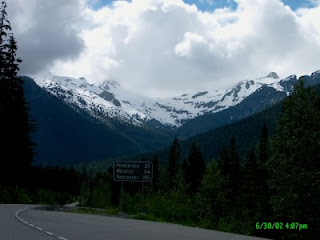
ABOVE: Pemberton Glacier as seen from Pemberton Pass

Gaining elevation into the Pass we noticed the warmer coastal air was being replaced by a cool breeze being swept down the mountains from the glaciers on the surrounding mountains. We stopped at a local Mecca for hikers, a destination called Joffre Peaks. Here you could do easy day hikes, hard day hikes to the upper two lakes in the shadow of the MattierGlacier, or if you were crazy enough you could climb on the glacier itself.

ABOVE: First Lake at Joffre Peaks
Us, we just went 10 minutes down the trail to First Lake,a green gem of a lake in the shadow of Joffre Peak. Even that was rewarding enough, and it required several photos to capture before the mosquitoes chased us back to the cars.

A few more minutes of climbing brought us to the full height of the pass, and the next 20 miles consisted of level travel, with a slight downward trend as we headed for Lillooet. As we went along the vistas had us continually chattering on the CB asking each other if we seen "that mountain", or "this peak", or "the lake back there".

Duffey Lake is the halfway point on the pemberton Pass,and it is a deep glacier carved narrow lake between two mountain peaks, and COLD !! BRRRRRRRR !!

ABOVE: Duffey Lake

Here we pulled out the sweatshirts and hats while we drank in the cool mountain scenery; avalanche chutes stretching from the mountain peaks 3000 feet above us running all the way down the mountain into the lake, reminded us of how truly wild this area was.

Quite often during winter this route is closed due to bad weather, snow accumulations and the danger of avalanches.

ABOVE: Cayoosh Creek (cayoosh is a derivative of the Native word "cayuse", meaning pony)

We continued on along the road still awed by the scenery presented around every new bend of the road. We reached the end of the lake, and drove alongside Cayoosh Creek as it ran angrily beside the road, almost at road level in spots.

Soon enough we started our steep descent from the high mountain pass, down through the sharp switchbacks where 20 miles an hour was too fast for the corner, and if you looked straight down you could see the highway a thousand feet below you.

Before we knew it we were spit out of the narrow valley pass where vertical walls 2000 feet tall were so close you swear you could throw a rock from one side and make it skip across to the other.

Suddenly we were down, no more second gear needed to hold us back.....we had reached the other side and the Fraser River was once again in site. We were now 2/3 of the way through our trip, and a stretch break at Seton Lake presented us with a contradiction of sorts.

We had started off in the cool, rain showered West Coast, right on the ocean with it's rain forest of Western Red Cedars, Douglas Firs and soaring waterfalls; then we climbed through a high mountain pass with peaks covered in year round glaciers that blew a cold wind on us, and now we were back in summer-like weather!!

The hot wind felt like a warm August breeze as it blew along the light green waters of the lake, and we were wondering how half an hour ago we could have felt so so cold even wearing a sweat shirts.

We shed our excess garments and rolled down the windows to let the summer in.The tall rain coast trees had been replaced by Ponderosa and Lodgepole Pines, interspersed with various Birch and Spruce species. The water loving wild ferns of the West Coast forest floor were replaced with bunch grass more conducive to rattlesnake territory.

We were in the rainshadow of the mountains, and the arid landscape was indicative of the low amount of precipitation that made it over themountains. All that water that we had as rain in Squamish was now destined for the glaciers in Pemberton Pass.

Lillooet is the Mile Zero on the Caribou Wagon Road of the Gold Rush Days.70 Mile House, 100 Mile House, 150 Mile House, all exist today due to their beginnings as stage coach stops during the 1890's; their names are indicative of their distance from Lillooet Mile Zero.

ABOVE: Mile Zero of the Caribou Wagon Road
We had a quick tour of the highlights of the town; the Mile Zero cairn, the Hanging Tree where Judge Begbie dispensed frontier justice to 8 men, similar to the legend of Judge Roy Bean; the remnants of gold diggings by the Chinese workers from the railroads; mountains of grave land bedrock all lined up in an orderly fashion; and the museum with it's placer gold mining equipment.

"The Bridge of the 23 Camels"; this is a new bridge named to commemorate the bright soul that thought camels would make an excellent pack animal in the arid land of the Thompson Plateau. Only problem was the soft feet of the camels was ripped apart by the hard rock of the trails.

By now a time check showed it to be 6.00 PM, and we still had many miles to go. We pushed on through the dry country as we now followed the Fraser River high above it on the bench lands formed thousands of years ago from a time when the Fraser was many times it's present size.

The landscape was more desolate then we were used to; sparse Ponderosa Pines with their reddish trunks sparingly covered the hillsides, prime habitat for deer, and we saw one right at the edge of the road feeding 4 feet of the highway. It was so well camouflaged that we did not see it until we were only 20 feet away!

The appearance of more farms and houses indicated that we were approaching Lytton. Here we wanted to see the contrasting colours of two rivers merging. The Thompson River flows a deep blue as it travels through the harder bedrock of it's watershed; cleaner gravel and less sediment means less contamination and a"purer" water column.

By contrast the Fraser's watershed is composed of more sandy and clay like hills and mountains, small particles easily suspended by the mighty river that contribute to it's "muddy" appearance. Where the two mighty rivers meet is a clash of colour and a fight for supremacy. The Thompson resists the embrace of the muddy Fraser for hundreds of feet downriver, but the Fraser eventually wins.

Where the two rivers first meet there is a fine line between blue and mud, just like someone took a pencil and drew a line. But we were denied this treat today..it was now 8.00 PM and the sun was disappearing behind the mountains, and the absence of bright sunlight caused the shadows to hide this exceptional sight. Somewhat disappointed we walked back tothe cars, but in true Backroader fashion we were already planning another day's adventure to this area.

Seeing as that we were about to enter the scenic Fraser Canyon in the twilight, we would be missing all the wonderful sights that this region has to offer. We decided to hold a future trip and take the day to explore the Fraser Canyon at a leisurely pace.

Back on the road we high tailed it south towards Hope and the end of daylight and the end of the tour. We pulled into Hope just as dark was falling, at 9.00 PM and had a late meal at one of the local restaurants that served meals that were too big, and HUGE portions of home cooked pies.

We fed our tummies with food and our brains with coffee, then feeling rejuvenated, we headed back out on the road for our last leg of the trip towards home.

It was an awfully long day that passed way too quickly, and the sights that we had seen continually amazed us, and I think I got a sore neck from whipping it around trying to see everything there was to see. It was an ambitious day, not for the faint of heart, and we made the most of it !!

In true Backroads mentality, knowing we missed a lot, and knowing there is so much more to see, that another Fraser Canyon trip won't wait too long before we are once again racing alongside the Fraser River rubbernecking at the Super Natural Scenery of BC

Friday, December 05, 2008

Travel Bug Hospital Caching Event in Surrey BC


Went to a caching event tonight hosted by Catapult Jeff and met the usual great group of cachers from around the Lower Mainland.

The event was listed as a chance to bring those travel bugs in need of some TLC to the "hospitable" to get fixed up, cleaned up, and back on the road to complete their mission in life.
MrTJ and I, tjguy98 (or as were known as, "The TJ Brothers"), attended the event and enjoyed the evening in the company of cachers we have known for a while. Plus we had the opportunity to meet some new cachers that we had not yet met up with on the trail.

The event was held at the ABC Restaurant in Surrey, and we had our own room for the group, which was nice way to do it.

Below is a 2 minute clip from the night; enjoy!


Tuesday, November 18, 2008

Car Caching in Langley

ABOVE: "Garage" at the "Gomer Pyle" cache
I decided that I would call this a day of "car caching" in Langley as most of the caches we did seemed to be car related. We found numerous caches in a series named after the cartoon movie "Cars". Even our first cache was called Gomer Pyle and it was located at a private garage where the owner was obviously a nostalgia buff as he had made the garage look like a service station from the 1950's.

The owner has installed two old gas pumps, placed old pop signs and an old temperature gauge near the office door, and had even placed an old roadster racing car from what I would guess is from the 1940s or older on the roof of the garage.

Mixed in among the car caches were a cache at a Starbucks, (always fun to try and be inconspicous there), a cache by the Nicomekl River, another cache in a flood zone along the Nicomekl River, (could not find that one), a skate board park cache, several neighbourhood park caches, and a cache in a green belt area that we have visted a few times before.
Along the way we ran into some fellow cachers and surprised them with the camcorder running. We got the basic reaction of "WHADAYA DOING WITH THAT CAMERA, WHADDAY FILMING US FOR"? Once we explained who we were, Mr and Mrs Bigbopper1 were put at ease, and we had a pleasant conversation with them about caching and other things in life.
ABOVE: The Albion Ferry

We capped the day off by taking a night time cruise across the Fraser River on the Albion Ferry on our way home to Maple Ridge.

I shot video continously during the day and have put togther the more interesting tidbits for you to view.

You can click on the video below to watch it here; you can also scroll down to the bottom of the page to see my other recent YouTube videos. Look for me on YouTube by searching for tjguy98


Monday, October 27, 2008

Cruising the Cascade Mountains


ABOVE: Hot air balloon taking off in Snohomish

On Saturday we had the pleasure of meeting up with the Backroad Drivers Northwest group in Everett for a pleasant Fall tour through small towns like Granite Falls, Verlot and Silverton before we took Barlow Pass north to the Darrington area. The road through the Barlow Pass is known as the Mountain Loop Scenic Byway.

Rather than me try to remember all the highlights of the trip, I'll instead post the trip report done by Jerry Horn. Jerry has a wonderful writing style, as well as a wonderful radio voice. When you watch the video....video you say? Why yes, I did do a video.....when you watch the video that deep, warm voice you'll hear over the C.B. is Jerry himself.
_________________________________________________________________

Trip Report Mountain Loop Tenth Year Celebration October 25, 2008

This run was a celebration of ten years of Backroad Drivers Northwest tours. We followed the same route as our very first tour and we enjoyed ourselves just as much this time as we did almost 200 trips and a decade ago.

We couldn't have had better weather as we met at Dennys Restaurant in south Everett, Washington. Joining in on the fun were Ed & Annette from Maple Ridge, BC; Rich & Jan from Beaverton, OR; Jim & Kerry and Jim's brother Ron from Lakewood, WA; Dave & Roberta from Edmonds and their daughter Cathy from Everett; Doug & Kathy from Lynnwood; Gary from Olympia; Mark from Lyman, WA; Sid & Mary from Renton; Phil & Laurel from Newcastle, WA with passenger Lizanne; Tom & Robbin with Tina riding; Jon & Melody; Alan; Fred; and us, Jerry & Evelyn fromYakima. I apologize to anyone I missed. I know we had 29 people for lunch and that was a bunch.

Our trek started by driving a busy county road from the restaurant near the freeway in Everett to the Seattle Hill Road where we finally got away from the congestion. We meandered down a curvy hillside into the Snohomish River Valley and crossed farmland to the town of Snohomish where we watched a hot air balloon take off. We drove county roads north of Snohomish including the Machias Road, the OK Mill Road, and the Newburg Road, around Lake Bosworth and into the town of Granite Falls where we made our first rest stop.

ABOVE: Granite Falls where there is a fish ladder that enables the fish to move upriver past the falls

Just out of town we stopped again to check out the falls and fish ladder then began our jaunt up the Mountain Loop Highway, now known as the Mountain Loop Scenic Byway. The road was paved and smooth, the weather was sunny, the leaves were all shades of yellows and greens, the twisty Stillaguamish River was beautiful and our group was busy commenting about various subjects over the C.B. radio as we enjoyed the drive.

After passing the community of Silverton and then the entrance to the Big Four Ice Caves we started feeling like we were in the mountains. When we reached Barlow Pass the pavement ended and an improved gravel road took us close to a majestic section of the Sauk River where huge boulders had been arranged by roaring currents with giant tree trunks wedged into the rocks like toothpicks.

The river was only a trickle today, but we could imagine how powerful it must be certain times of the year.

ABOVE: We turned the road into a parking lot!

Our road was just wide enough to pass on coming traffic and with the exception of a few potholes it was in pretty good shape. We drove slowly along the river and stopped at a wide spot in the river called Monte Cristo Lake. It was more of a pond, but the setting was scenic and we enjoyed the stop. The road continued through a heavy forest of firs, hemlocks and hardwoods. Leaves had turned and the colors were beautiful. At one point the evergreens all but disappeared only to be replaced by deciduous trees with falling leaves sashaying back and forth on their way to the partially covered roadway. It was very pretty indeed.

ABOVE: Monte Cristo Lake on the Mountain Loop Highway

We made another stop at the Whitechuck Mountain Rest Area where we managed to find a place for all thirteen of our vehicles and take advantage of the primitive facilities. It was a little foggy at the higher elevations so we could not see the mountain, but it was still a nice place for a rest. Within a short distance of the rest area we hit pavement and followed it intothe mountain town of Darrington where we stopped for lunch. The restaurant had a room set up for us and we filled it, all twenty-nine of us! I don't know about the rest of them, but my burger was great.

After lunch we continued following the Sauk River on Hwy 530 until we turned off on the Concrete-Sauk Valley Road. We were still on pavement, but on the opposite side of the river. It was the same road, but the name changed to the South Skagit Highway soon after the confluence of the Sauk and Skagit Rivers. We followed the Skagit River until we reached civilization on the outskirts of Sedro Woolley.

We were only a few miles from Interstate 5 via Burlington or Mount Vernon where we gathered at a park-and-ride to say our goodbyes. Evelyn and I really enjoyed seeing everyone. We had a great day and we sincerely thank you for coming.

Jerry________________________________BACKROAD DRIVERS NORTHWEST


Tuesday, September 30, 2008

Caching in the BC Interior

ABOVE: Old truck we came across in Chilliwack

Had a week off from work and decided that the best way to spend it was to have a caching week. But what to do....hmmmm.....I know. Two of my brothers are retired, may be they would want to do a road trip!
And that's just what we did: from Vancouver to Kamloops, through to Vernon, on to Kelowna and back down to Vancouver, all done over the course of 4 days.

The complete set of pictures can be viewed here on my Flickr site

It was a "boy's" weekend away, no wives allowed! Just 3 addicted male cachers spending the entire day, and some of the night, driving and caching.

We left the Vancouver area late morning and drove up to the Agassiz area where we stopped occasionally to find caches in the area. Not a lot, just enough to wet our appetite for the drive up to Kamloops.ABOVE: Mile Marker 97

One of the more memorable caches we found was, well, memorable! It was a piece of history from the 30's or 40's, back when the main road east from Vancouver was not a main freeway, but a succession of roads where Mile Zero is at the main Vancouver Post Office in downtown Vancouver. Along Main street to Kingsway, then into Burnaby and over the old bridge to Surrey, then out along the Fraser Highway into the Fraser Valley.

100 Miles from Vancouver to Hope, and at every mile was a stone cairn with the mile number engraved on it. This time we were at Mile marker 97, it stands on what was a busy Old Yale Road which itself starts at the shore of the Fraser River in Surrey and runs all the way to Hope.

Now the road is covered over by other streets or in sections a mere shadow of what it once was; here on the outskirts of Hope, Old Yale Road is a quiet residential street and the cairn is on a neighbour's boulevard.

We quickly found the small container with the log book inside, signed the book, and enjoyed this little piece of history resting comfortably on the shoulders of an old highway companion.

Back in the truck we headed up the Coquihalla Highway picking up a drive up cache at a truck rest stop, then continued on to a threesome of caches along a road that acted as a byway around the toll booths.ABOVE: The start of the bypass road at the south end

This road is suited only for vehicles with high ground clearance like a truck; we did it in Al's pick up but even so we bottomed out in one area. As we were heading south to north, the road headed down into the valley north of the Coquihalla Summit. The road was rough and broken in places; south to north is the easy way. If I was coming from the north and had to climb the worn out section of forest road, I think I would want to have a 4X4 rather than a two wheel truck. But we made it, found all three caches; one at the south end, one in the middle, and one at the north end.

We pulled into Merritt and made the usual stop at Tim Hortons for a coffee and a quick snack; phone calls were made to the home fronts to let the loved ones know we were still alive and well, then we pushed on north through Merritt taking the old Hwy #5A out of town.

We were into a different part of BC; this was one of rolling hills, bunch grass, arid hills with barely a tree to be seen. We were now in cowboy country! Gone was the West Coast forest consisting of giant cedars and firs; we left that behind when we took the bypass around the Coquihalla Summit.

We had left the main highway in the Coquihalla Valley surrounded by lush vegetation supported by 110 inches of rain a year. Just 24K up the valley and beyond the bypass road, the rain shadow effect from the mountains kicked in. Now we where in a semi-arid biozone where the average rainfall was less than 30 inches.

As a matter of fact, much of our trip would be through this very same biozone; hot in summer, cold in winter, and little precipitation year round made for a land that only supported small trees and plants, at least compared to the coast.

ABOVE: Nicola Cemetery

We stopped at caches along Hwy 5A, the first exciting one being the old Nicola Cemetery on the south shores of Nicola Lake. We wandered around the old graves as we wondered what it was like in the early days.

The name "Nicola" was given to the famous chieftain Hwistesmetxque by the early fur traders, as they could not pronounce the chieftain's name properly. When they tried to say it phonetically it sounded like "Nicolas" or "Nicola", and the incorrect pronunciation became the name of the valley, the lake, and the surrounding area still used today.
ABOVE: Historic marker on Old Kamloops Road

Further along the highway we stopped on the east side of Stump Lake on the Old Kamloops Road for a cache placed at a historic marker. Just being on the Old Kamloops Road (the main road from Merritt to Kamloops long before the coming of the modern highway, and long before the 4 lane Highway #5 that now carries most of the traffic headed for points north) was cool enough, but this cache was placed at a point on the lake where one of the original Hudson Bay Brigade trails skirted the lake.

In use from 1849 to 1860, this trail was an important byway for the bringing of furs from Fort Kamloops to Fort Vancouver. The brigades consisted of over 400 horses and 100 men; each of the horses was laden with a bulging sacks filled with furs from animals trapped in the Interior.ABOVE: "Once the grass was as high as a horse's belly"

As we continued on the road we had excellent views of what were once rolling fields of grass as high as a horse's belly; this area was one of the places where ranches sprung up and the miners turned their eyes from gold in the form of nuggets to gold in the form of horses and cattle. Sad to say the grass is no where near what it was then, a result of over grazing.

We continued further up Hwy 5A and were surprised when we reached the far outskirts of Kamloops, only to see the the term "far outskirts" no longer applied. The city had expanded south up the hills away from the Kamloops Valley and was now claiming land in the form of sub divisions.

By now it was dinner time and we were behind our projected schedule, so we opted to cache until dark, then grab a motel to ensure a room for the night. Once that was secured, we went back out into the night and picked up another 8 caches, then grabbed a late dinner and went back to the motel to crash.

Up in the morning to a steady down pour.....ewww..doesn't sound too nice out there! But we were in luck; by the time we had finished breakfast and checked out of the room, the rain had all but stopped and the skies were brightening. The rest of the day we spent caching in the Kamloops area, working our way east out of town headed for the highway that would take us down through Falkland and Westwold as we aimed towards Vernon.ABOVE: East of Kamloops the ancient bench of the Thompson River is plainly evident

Many of the caches on this side of town were located high on the ancient benches of the Thompson River. 10,000 years ago, when the mighty glaciers were melting, the Thompson River was hundreds of feet deeper and reached the tops of the surrounding hills, and across the width of the valley. Many of the provinces rivers were giants compared to now, carving deep valleys as they scoured the earth beneath their waters, only to leave a river a fraction of their true size at the bottom of large valleys.

How big where the rivers 10,000 years ago as they carried away the frigid ice waters of the continental ice sheets? Picture this... stand at the top of Grouse Mountain on the North Shore of Burrard Inlet in Vancouver. Now get in your car, drive over the border, past Blaine, past Bellingham and stop on the highest peak in the moutain range south of Bellingham. You have just defined the north and south shores of Glacial Fraser River that carried such a volume of meltwater and suspended ground material that it layed down a layer of sediment 1 mile deep 100 miles inland from the ocean. This fertile land created from the sediment of what once was eroded mountains and scoured upland Interior plains is what we now know as the Fraser Valley. Try to imagine, that as you drive through Abbotsford and Chilliwack on your way to Hope, that the actual bed rock of the land is one mile beneath your feet!ABOVE: Old Chevy truck

We rolled through Monte Creek, Monte Lake, Westwold and into Falkland where we spotted a used car lot with many vintage cars. Most of these cars were restored to running shape but they still needed a lot of work to call them restored. We stopped in for a look see and ended up talking to the owner for a while. Al and Ken created a new customer for their business; they have a business called KAR Books and sell old car manuals, along with other type of repair manuals, online, at car swap meets, etc.

As they talked shop, I wandered around the lot snapping off pictures of a dozen or so old vehicles for sale. Not that I'm all that into vintage cars, but it's still nice to see them being saved all the same.ABOVE: Falkland Valley

Just out of Falkland, we turned up a side road and headed for a forest road that would take us up the side of a mountain for a cache that had been out for a month but only had two vistors. In the city, there would have been 20-30 visitors to the cache already We nearly tripled the number of visits to this cache just by the three of us signing the log book. The cache was located just off an old skid road about 7K up the main FSR; the cache location gave us an wonderful view of the Falkland Valley which emphasized the fact we had transitioned biozones again.

We had moved from the dry Interior zone to the Wet Interior zone; gone were the sweeping open lands of grass and rolling hills; instead we were now into mountains complete with forests and logging trucks.

But that wouldn't last long; as we travelled the highway we crested a mountain pass and began our descent down into the north part of the Okanagan Valley, down to the shores of Okanagan Lake. While we did this, we traversed back into the Dry Interior Zone and once again the forests were replaced by Ponderosa Pines and aspens. There were more trees here than the Merritt area, and more green areas, but it was still a dry environment.ABOVE: Okanagan Landing, site of the terminus of the CPR line and the terminus of the Okanagan Lake paddle wheeler service

Once again we did a last few caches as night fell, then went in search of a room for the night. After that, we made our way to the south side of Vernon to Okanagan Landing to visit our brother Wayne and his wife Inga. Okanagan Landing is an historic site in itself; is was the landing site for the stern wheelers that plied Okanagan Lake. Paddlewheel Park now occupies the site where the CPR had a ship building operation and a major terminus where steam ships met trains that took passengers further south on their voyage to places like Penticton. There the passengers could continue their train travels on the Kettle Valley Railway east to Midway or south to Kelowna.

The new day found us still in Vernon while we finshed up our list of caches; some of the interesting locations we found was the old BX ranch where they raised horses for the stage coach company that ran a route into the Caribou region and another from Priest's Valley (Vernon area) to Cache Creek and Okanagan Mission (present day Kelowna). Francis Barnard, founder of the B.C. Express and Stage Line, commonly known as the Barnard Express, sent his men to Mexico in 1868 and drove back 400 horses that he had bought as breeding stock for the stage lines. The ranch he founded 5 miles east of present day Vernon became known as the BX ranch.ABOVE: Plane on the roof of the Vernon legion

We also found a cache at the local legion; doesn't sound too interesting you say? Well, this legion has an old airplane mounted on it's roof! Now that's something you don't see every day...

The next day found us in Kelowna with still a whole whack of caches on our list; as usual I had printed off way more than we would be able to do. But by doing so I had ensured we would not run out of caches, plus if we had to change plans we had some spare caches to search for. Those that were not found would go back on the pile to be found next time we come this way.

In Kelowna one of the areas we spent some time in was the Mission Creek area; this is a linear park that follows Mission Creek as it flows through the suburbs of town. The park has something for every one; in areas there are playgrounds and open grass areas for playing on; another area has a small fish hatchery incorporated into the creek for the benefit of the local community to enjoy the wonders of the natural cycle of salmon.

Other areas are left in a more natural state and good walking trails take advantage of the stillness of the dry forest land. We found 7 or 8 caches all together along the length of the park, and we enjoyed each area we visited. ABOVE: Sibell Maude-Roxby Bird Sanctuary on the shores of Okanagan Lake in Kelowna

A few more caches in town brought us right to the heart of Kelowna on the shore of Okanagan Lake. One of the caches was in a bird sanctuary where an elevated boardwalk built over a marsh adjoining the lake let you enjoy the area with out disturbing the environment. Another cache brought us into a wet lands area a few hundred feet from the lake. The wetlands are no doubt affected by the rise and fall of the water table at the lake as the whole area is basically at lake level.

It was getting late in the day and we wanted to do a few more caches on the way home, so we skipped the other caches on the pile and started the long trek towards Vancouver. We did a couple of caches along the Connector that runs from Westbank to Merritt, but these were mostly stop and grab caches, nothing exciting here other than a chance to stretch your legs. ABOVE: Small family cemetery in Merritt

In Merritt we did a cache that turned into a combination rest stop and history lesson. This cache was at an old grave yard just on the eastern edge of town; the grave markers here were all made of wood which indicated that most of the people buried here were poor. It is a family cemetery were 6 or 7 of the Moses family are buried; they died during a smallpox epidemic.

After finding the cache we took a look around the small cemetery, so rich in history, and then piled into the truck for the long drive home.

We put approx 700K on the truck over the 4 days, and found approx 100 or so caches; we could have found a lot more in two days if we stayed in Vancouver, but there is so much history and beautiful land to see in B.C. that you do yourself an injustice by staying in town. Over the 4 days we did many caches that I did not mention, as that would be too ponderous for me to write and for you to read. I incorporated the ones that stood out from the others, the ones were the cache owners brought us to a beautiful view or shared a piece of history with us. For that we say thank you!

Friday, September 26, 2008

Driving the KVR With Scruffster Riding Shotgun

ABOVE: Engineers Road in Manning Park


Last Saturday I did one of my favourites drives in this corner of B.C., and as an added bonus I had Scruffster (Stu) along riding in the shotgun seat.


Stu is basically a city boy who doesn't often get the chance to experience the wonders that B.C. has to offer, so it was with great pleasure that I was able to offer him a ride for the day to enjoy the scenery.


The goal today was to follow the route of the old Kettle Valley Railway (KVR) from Princeton north through the Otter Valley, then hang a left approx 30 miles up the valley and head west to the old railway stop of Brooksmere.


The four part video may be viewed on my YouTube channel here. Look for the videos titled "Princeton-Coalmont-Tulameen With Scruffster" and start with Part One

We started off in Maple Ridge at 7.00 AM where Stu dropped off his car and climbed into the Jeep with just a bit of a buzz happening with the expectation of things to come. Stu had been out just the other weekend with me as we did the Harrison West FSR Geocaching tour, so he had some idea of the sights we would be seeing and the roads we would be travelling. Even so I think by the end of the day he was awed by the scenery, and just a wee bit over whelmed by the amount of territory we covered.

We drove the 90 minutes to Hope with no stops along the way as we wanted to keep to the agenda, knowing that the day would be turning dark on us at some point earlier then we wanted it to.

Our first stop was just east of Hope on Hwy#3 at a camping spot called Nicola River Campsite. It was a campsite that I had used way back in 1980 with my brand new truck and camper as a shake down sleep over. While the rain poured down, I was having a cup of tea reading the local newspaper while the furnace kept it nice and toasty in the camper. This was a far cry from the days of sleeping in a sleeping bag out in the open at Garibaldi Lake and waking up to ice on the sleeping bag.

ABOVE: The Hope Slide

Next up were 3 caches at the Hope Slide further east on Hwy#3. The Hope Slide is one of the biggest slides in to happen in Canada; it was triggered by rain water loosening the slopes which first created a minor mud slide that blocked the highway. Then, approx three hours later, a minor earthquake triggered the larger slide that broke away half the mountain. This happened on Jan 9, 1965 and 2 people in two cars are still missing. Four people in all were killed.


At the slide the 3 caches consisted of 2 real caches and one Earth cache; the Earth cache is a virtual cache where you go to a location and find out some information about the unusual earth fomation, in this case the slide. Real caches found and the necessary information collected for the virtual cache, we moved on down the road.

ABOVE: Westgate of Manning Park

The next 8 caches were all inside Manning Park; the caches highlighted some of the natural beauty of the area. The cache locations took us from the old Dewdney Trail to it's succesor, the Engineer's Road, from rare large rhodendrons to swift flowing creeks, with highlights of beaver and mule deer environments thrown in for good measure.


Manning Park consists of over 70,844 hectares of rugged forest-clad mountains, deep valleys, alpine meadows, lakes and rivers. There are numerous campsites in the park, most drive in along with some alpine areas. There is a downhill ski area, a lodge, a full service cafeteria and store and public washrooms for the weary road travellers.

Manning Park also straddles several bioclimate zones; at it's western entrance the park is west coast rain forest with green trees and plants every where you look. Creeks, rivers, and waterfalls are the norm on this side of the park. As you move towards the centre of the park you climb into Allison Pass and lose the west coast feel; it is replaced with smaller trees and less ground cover due to the harsher winter environment.


By the time you get to the lodge and store area, you are in the midst of a high altitude environment; the winters bring heavy snow and it is reflected in the types of structures here. All of the buildings have steep pitch roof lines to minimize snow build up and you notice that many of the signs are placed at a height where they will still be visible even when the winter's snows come.


Moving east you cross from the west coast zone to the dryer Interior climate zone. Here the ground is dryer and the trees have changed from firs and evergreens to lodgepole pines and birch. Dry brownish grazing grass fills the voids between the trees and the deer population explodes in the area. Where you had to be lucky to see a deer to the west, now when you drive this section at night you have to be lucky not to hit a deer.

We exited the east side of the park, got half a mile away when Stu noticed a moose at the river's edge. "A moose"? I said, here in the dry semi-arid Interior? Well, yes there was one right there!


Moose generally prefer wet marsh areas to arid environments, so we could only surmise that this moose was at the edge of it's territory.


On we went towards Princeton picking up a couple of caches along the way. By now we were fully into the dry lands, and sage brush grew in the fields instead of shrubs; we also noticed in this environment every plant seemed to have thorns or prickles that clung to your clothing as you walked past.

Into Princeton we went searching out the caches planted in this small city; an added bonus was grabbing an FTF in the Tulameen Turtles region. The Turtles are very dedicated cachers who think nothing of driving all night down forest roads searching for an FTF at a distant cache. Their fleet includes 4X4's and ATVs, augmented with a quaff of the finest wines avilable to geocachers on low budgets. To get the jump on them is tough to do; to do so in their own back yard was particularly sweet!

ABOVE: Old building in Granite City

Out of Princeton we went to Coalmont, where the treat for the day was the old ghost town of Granite City. History buff Stu had a field day here, savoring every nuance of the old buildings and the open area that was once a town of two thousand people and two hundred buildings, of which 13 were saloons.

We wandered around the old city for a while, then went up the hill to look at the old Granite City cemetery with head stones so old some of them were unreadable.

Back on the road to the town of Tulameen and home of the Tulameen Turtles which we hoped to surprise. But alas our timing was off as Mrs. Turtles had dropped by my house with some CDs of a recent trip we were on, and found out that I was headed to their territory. Mr Turtles was not home either, but had left a note for us to make our selves at home.


We wandered around the yard for a few minutes thinking how lucky they were to have the cabin to escape to on the weekends.


ABOVE: Old Kettle Valley Railroad trestle at the south end of Otter Lake

We did a few more caches in the Tulameen area, the best of which was the old train trestle from the days of the KVR. The trestle is at the southern end of Otter Lake and you have an excellent views of the lake from the old train bed and the bridge.

ABOVE: Old barn in the Otter Valley

Back on the road we headed north up the Otter Valley stopping at many viewpoints to admire the view and capture it on film and video. We had also changed bioclimate zones again; we had left the dry Interior area and where now in a wetter grass lands area as we travelled the valley bottom. Tracts of cattle ranches were the norm now as we climbed into onto the Nicola Plateau. This was home to historical ranch names like the Nicola Ranch and the Douglas Lake Ranch; these ranches made their fortune on feeding the hungry men who laid the steel rails of the railways and selling horses in Western Canada to the growing population.


By now it was early evening and we were beginning to run out of light; we made the run up the Otter Valley as far as the turn off for the Brookmere Road, which took us west towards the old railway town of Brookmere near the Coquihalla Highway. As we cruised along the old rail bed turned-back road we couldn't help but think of the old whistle stops along here and the pioneer men and women who lived on isolated ranches far from one another; the only way to town was a very long and bumpy wagon ride, or the luxury of the KVR trains.

Our last stop was at Brookmere, where a cache was placed at the only remaining water tower still standing from the KVR line. These water towers were unique in that they were multi-sided and not round like the other train lines built.


We exited the KVR route back onto the Coquihalla Highway and once again we were in another bioclimate zone. Now we were back into the high passes of the mountains were winter comes early, stays late, and dares you to drive the highway any time of the year. This is one of those mountain highways were it's not unheard of to have snow in August!


By now we were in the dark, we were way past our allotted day light hours, and we made the drive back to Vancouver in the dark accompanied by a steady mountain downpour. We had managed to miss the rains that enveloped the coast during the day by the fact we were on the other side of the Coast Mountain Range. Once we reached the Coquihalla Summit and started down the mountain pass, we ran smack dab into the bad weather that Vancouver had been experiencing in our abscence.


We arrived back in Maple Ridge at Stu's car around 10.00 PM, meaning we had been on the road for 15 hours, all of which flew by in what seemed like minutes.


Stu headed home to crash, I headed home to clean up the Jeep and pack for a 4 day geocaching road trip that started at 6.00 AM the next morning!


Thanks Stu for riding shotgun for the day and being such good company!

Tuesday, September 16, 2008

Caching Along Harrison Lake West FSR

On Saturday Sept 13 I had the pleasure of hosting a geocaching event for some of the local members of the BCGA. I lead a group of people in five 4X4s as we cached north along the west side of Harrison Lake.

We met at the Tim Hortons in Mission in the central Fraser Valley where we all enjoyed a large morning cup of coffee to help wake us up; the breakfast sandwiches were pretty good too!

After ensuring we were all the folks that were going to show up, we picked a rendezvous point at Weaver Creek Fish Hatchery where we would drop off some of the cars, move the ride alongs over to the 4X4s, and find our first cache!

A total of 14 caches were found on the trip today that stretched more than 50 miles from Harrison Mills in the south, to the Tipella logging camp at the north end of Harrison Lake. By my total we were on gravel roads for approx 110 miles; roads that were at times good graded gravel that you could only curse due to the dust, to no road at all as the road was washed away by the water running down the old road bed. At times we struggled to see over the hoods as the front end was pointed decidedly uphill towards the sky!


Rather than go into all the caches we found explaining their names, locations, etc, I can show you! This time out I took my new cam corder for it's inaugural outing, and I put it to good use. I shot off 45 minutes of film, which I have edited down to about 30 minutes.

You can view the videos here on YouTube; look for the three part Harrison Lake FSR Tour videos. Or you can search Youtube for tjguy98 to find my channel.

Start with Part 1 (of course), then Part 2 and Part 3 to keep the story line in order.

Enjoy the videos and hope it makes you feel like you were right there with us......minus the dust....and the heat.....and the bumping around in the washed out sections of road.....and the crashing through the bush to find the caches getting all scratched up with what I'm sure is poison ivy!!!!!

Other than those little differences, you'll feel like you were there!

PS For those of you who really wanted to come along but didn't, read the write up right after you have dumped the bag from the vacuum cleaner all over your hair. THEN you'll get the idea of how we felt at the end of those 110 miles of FSR travelling.

Sunday, September 07, 2008

Messing About in Maple Ridge

ABOVE: Trailhead for the Canyon Trail in Kanaka Creek Park

I made time for myself this week end to get out and do a little caching.; only the second time in months that I've been out playing.

As usual I fired off a few pictures, (you're lucky this time, only 20 or so) and I've put them up on my Flickr page to view. Click here to be magically swept away to Eddie's World.....